What is the difference in data transmission delivery and reliability between TCP and UDP?
ATCP transmits data at a higher rate and ensures packet delivery. UDP retransmits lost data to ensure applications receive the data on the remote end.
BUDP sets up a connection between both devices before transmitting data. TCP uses the three-way handshake to transmit data with a reliable connection.
CUDP is used for multicast and broadcast communication. TCP is used for unicast communication and transmits data at a higher rate with error checking.
DTCP requires the connection to be established before transmitting data. UDP transmits data at a higher rate without ensuring packet delivery.
Correct Answer:D
Q487(none)
How does QoS optimize voice traffic?
Areducing bandwidth usage
Bby reducing packet loss
Cby differentiating voice and video traffic
Dby increasing jitter
Correct Answer:C
Q488(none)
What are network endpoints?
Aact as routers to connect a user to the service prowler network
Ba threat to the network if they are compromised
Csupport inter-VLAN connectivity
Denforce policies for campus-wide traffic going to the internet
Correct Answer:B
Q489(none)
What does physical access control regulate?
Aaccess to spec fie networks based on business function
Baccess to servers to prevent malicious activity
Caccess :o computer networks and file systems
Daccess to networking equipment and facilities
Correct Answer:D
Q490(none)
What must be considered when using 802.11a?
AIt is compatible with 802 lib- and 802 11-compliant wireless devices
BIt is used in place of 802 11b/g when many nonoverlapping channels are required
CIt is susceptible to interference from 2 4 GHz devices such as microwave ovens.
DIt is chosen over 802 11b/g when a lower-cost solution is necessary
Correct Answer:B
802.11a and 802.11b are not compatible since 802.11a operates at the 5GHz frequency band and 802.11b operates at the 2.4GHz band. The 2.4 GHz frequency band with a channel width of 22 MHz only has 3 nonoverlapping channels (1, 6 and 11) whereas the 5 GHz band has 23 non-overlapping channels with a 20 MHz channel width. Therefore, 802.11a is preferred over 802.11b and 802.11g when many non-overlapping channels are required since they both operate at 2.4GHz unlike 802.11a.
Q491(none)
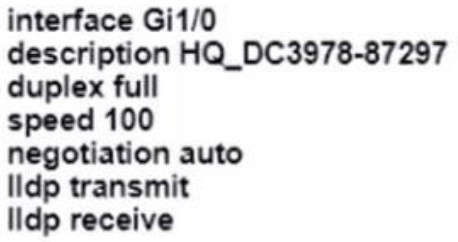
An engineer configures interface Gi1/0 on the company PE router to connect to an ISP Neighbor discovery is disabled. Which action is necessary to complete the configuration if the ISP uses third-party network devices? A. Enable LLDP globally
BDisable autonegotiation
CDisable Cisco Discovery Protocol on the interface
DEnable LLDP-MED on the ISP device
Correct Answer:A
LDDP-MED is used only between network devices (such as switches) and endpoint devices (such as phones). For network-to-network connections, LLDP is used. Check table 2, protocol uses https://www.cisco.com/en/US/technologies/tk652/tk701/technologies_white_paper0900aecd804cd46d.html
Q492(none)
Which two events occur automatically when a device Is added to Cisco DNA Center? (Choose two.)
Choose 2 — select all that apply
AThe device Is assigned to the Global site.
BThe device Is placed into the Unmanaged state.
CThe device Is placed into the Provisioned state.
DThe device Is placed into the Managed state.
EThe device is assigned to the Local site.
Correct Answer:AD
Device in Global Site: When you successfully add, import, or discover a device, Cisco DNA Center places the device in the Managed state and assigns it to the Global site by default. Even if you have defined SNMP server, Syslog server, and NetFlow collector settings for the Global site, Cisco DNA Center does not change these settings on the device. https://www.cisco.com/c/en/us/td/docs/cloud-systems-management/network-automation-and-management/dna-center/2-1-2/admin_guide/b_cisco_dna_center_admin_guide_2_1_2/ b_cisco_dna_center_admin_guide_2_1_1_chapter_010.html
Q493(none)
What are two benefits of using the PortFast feature? (Choose two)
Choose 2 — select all that apply
AEnabled interfaces are automatically placed in listening state
BEnabled interfaces come up and move to the forwarding state immediately
CEnabled interfaces never generate topology change notifications.
DEnabled interfaces that move to the learning state generate switch topology change notifications
EEnabled interfaces wait 50 seconds before they move to the forwarding state
Correct Answer:BC
A switch will never generate a topology change notification for an interface that has portfast enabled. https://networklessons.com/switching/cisco-portfast-configuration “Another major benefit of the STP portfast feature is that the access ports bypass the earlier 802.1D STP states (learning and listening) and forward traffic immediately.” https://www.ciscopress.com/articles/article.asp?p=2995351&seqNum=3
Q494(none)
A network administrator is asked to configure VLANS 2, 3 and 4 for a new implementation. Some ports must be assigned to the new VLANS with unused remaining. Which action should be taken for the unused ports?