What is an advantage of Cisco DNA Center versus traditional campus device management? A. It supports numerous extensibility options including cross-domain adapters and third-party SDKs.
BIt supports high availability for management functions when operating in cluster mode.
CIt enables easy autodiscovery of network elements m a brownfield deployment.
DIt is designed primarily to provide network assurance.
Correct Answer:A
Q217(none)
While examining excessive traffic on the network, it is noted that all incoming packets on an interface appear to be allowed even though an IPv4 ACL is applied to the interface. Which two misconfigurations cause this behavior? (Choose two)
Choose 2 — select all that apply
AThe packets fail to match any permit statement
BA matching permit statement is too high in the access test
CA matching permit statement is too broadly defined
DThe ACL is empty
EA matching deny statement is too high in the access list
Correct Answer:BC
Q218(none)
How do traditional campus device management and Cisco DNA Center device management differ in regards to deployment?
ACisco DNA Center device management can deploy a network more quickly than traditional campus device management
BTraditional campus device management allows a network to scale more quickly than with Cisco DNA Center device management
CCisco DNA Center device management can be implemented at a lower cost than most traditional campus device management options
DTraditional campus device management schemes can typically deploy patches and updates more quickly than Cisco DNA Center device management
Correct Answer:A
Q219(none)
How do AAA operations compare regarding user identification, user services and access control?
AAuthorization provides access control and authentication tracks user services
BAuthentication identifies users and accounting tracks user services C. Accounting tracks user services, and authentication provides access control
DAuthorization identifies users and authentication provides access control
Correct Answer:B
Q220(none)
What is a difference between local AP mode and FiexConnet AP mode?
ALocal AP mode creates two CAPWAP tunnels per AP to the WLC
BFiexConnect AP mode fails to function if me AP loses connectivity with the WLC
CFlexConnect AP mode bridges the traffic from the AP to the WLC when local switching is configured
DLocal AP mode causes the AP to behave as if it were an autonomous AP
Correct Answer:A
Q221(none)
Which function does the range of private IPv4 addresses perform?
Aallows multiple companies to each use the same addresses without conflicts
Bprovides a direct connection for hosts from outside of the enterprise network
Censures that NAT is not required to reach the internet with private range addressing
Denables secure communications to the internet for all external hosts
Correct Answer:A
Q222(none)
What event has occurred if a router sends a notice level message to a syslog server?
AA TCP connection has been torn down
BAn ICMP connection has been built
CAn interface line has changed status
DA certificate has expired
Correct Answer:C
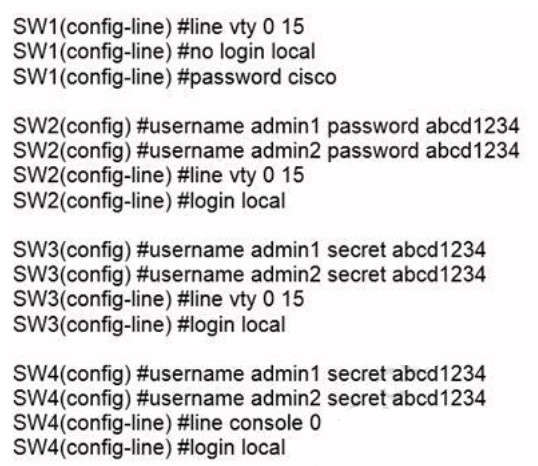
QUESTION 223 Refer to the exhibit. An administrator configures four switches for local authentication using passwords that are stored in a cryptographic hash. The four switches must also support SSH access for administrators to manage the network infrastructure. Which switch is configured correctly to meet these requirements? A. SW1 B. SW2 C. SW3 D. SW4 Correct Answer: C Section: (none) Explanation Explanation/Reference:
Q224(none)
What are two fundamentals of virtualization? (choose two)
Choose 2 — select all that apply
AThe environment must be configured with one hypervisor that serves solely as a network manager to monitor SNMP traffic
BIt allows logical network devices to move traffic between virtual machines and the rest of the physical network
CIt allows multiple operating systems and applications to run independently on one physical server.
DIt allows a physical router to directly connect NICs from each virtual machine into the network E. It requires that some servers, virtual machines and network gear reside on the Internet
Correct Answer:BC
Q225(none)
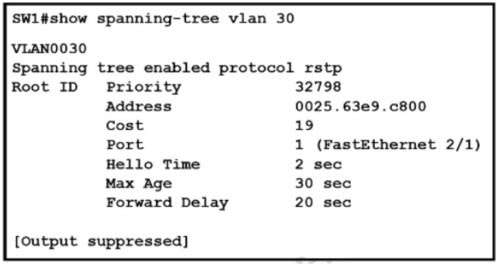
Refer to the exhibit. What two conclusions should be made about this configuration? (Choose two)
Choose 2 — select all that apply
AThe designated port is FastEthernet 2/1
BThis is a root bridge
CThe spanning-tree mode is Rapid PVST+
DThe spanning-tree mode is PVST+
EThe root port is FastEthernet 2/1
Correct Answer:CE
Q226(none)
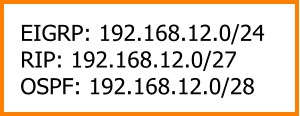
Refer to the exhibit. A router reserved these five routes from different routing information sources. Which two routes does the router install in its routing table? (Choose two) A. RIP route 10.0.0.0/30