R1 has learned route 10.10.10.0/24 via numerous routing protocols. Which route is installed?
Aroute with the lowest cost
Broute with the next hop that has the highest IP
Croute with the shortest prefix length
Droute with the lowest administrative distance
Correct Answer:D
Q207(none)
Which action must be taken to assign a global unicast IPv6 address on an interface that is derived from the MAC address of that interface?
Aconfigure a stateful DHCPv6 server on the network
Benable SLAAC on an interface
Cdisable the EUI-64 bit process
Dexplicitly assign a link-local address
Correct Answer:B
Q208(none)
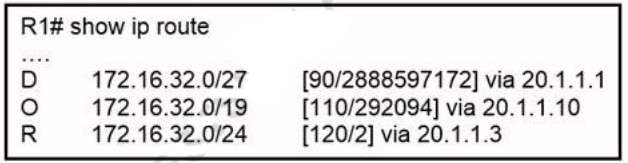
Refer to the exhibit. Router R1 is running three different routing protocols. Which route characteristic is used by the router to forward the packet that it receives for destination IP 172.16.32.1?
Alongest prefix
Bmetric
Ccost
Dadministrative distance
Correct Answer:A
Q209(none)
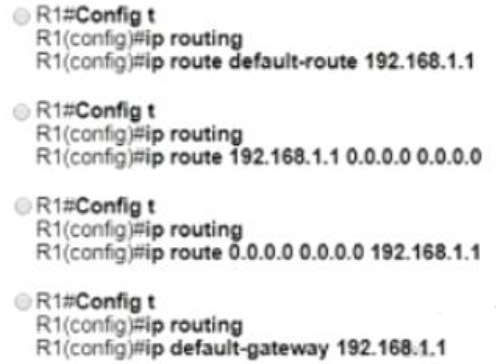
Router R1 must send all traffic without a matching routing-table entry to 192.168.1.1. Which configuration accomplishes this task? A. Option A
BOption B
COption C
DOption D
Correct Answer:C
Q210(none)
Which WPA3 enhancement protects against hackers viewing traffic on the Wi-Fi network?
ATKiP encryption
BAES encryption
Cscrambled encryption key
DSAE encryption
Correct Answer:D
Q211(none)
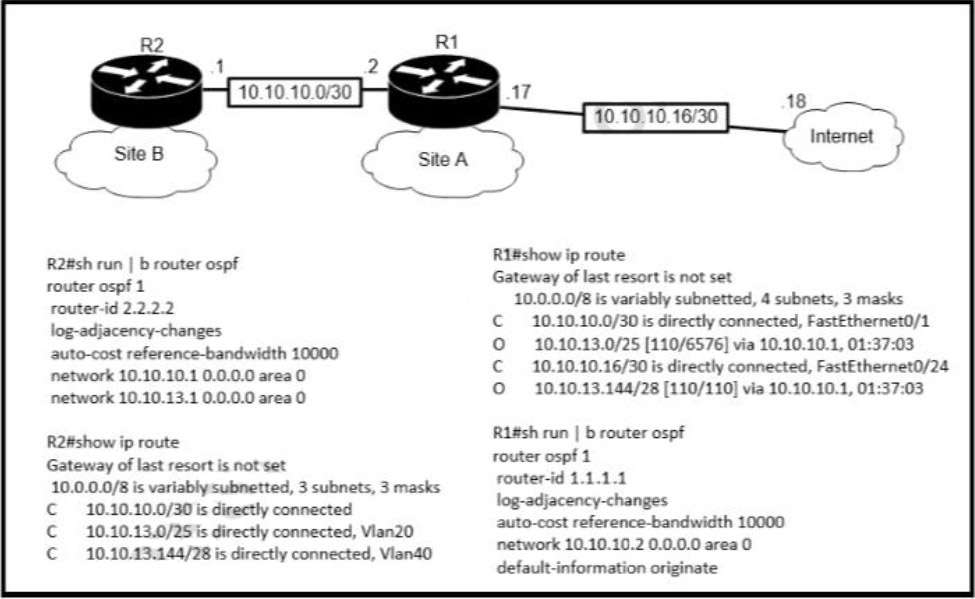
Refer to the exhibit. An engineer is bringing up a new circuit to the MPLS provider on the Gi0/1 interface of Router1 The new circuit uses eBGP and teams the route to VLAN25 from the BGP path What s the expected behavior for the traffic flow for route 10.10.13.0/25? A. Traffic to 10.10.13.0.25 is load balanced out of multiple interfaces
BRoute 10.10.13.0/25 is updated in the routing table as being learned from interface Gi0/1.
CTraffic to 10.10.13.0/25 is asymmeteical
DRoute 10.10.13.0/25 learned via the GiO/0 interface remains in the routing table
Correct Answer:B
Q212(none)
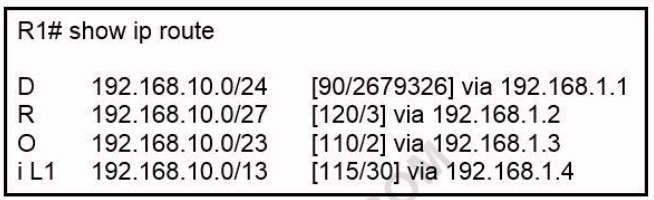
Refer to the exhibit. How does router R1 handle traffic to 192.168.10.16? A. It selects the IS-IS route because it has the shortest prefix inclusive of the destination address.
BIt selects the EIGRP route because it has the lowest administrative distance.
CIt selects the OSPF route because it has the lowest cost.
DIt selects the RIP route because it has the longest prefix inclusive of the destination address.
Correct Answer:D
Q213(none)
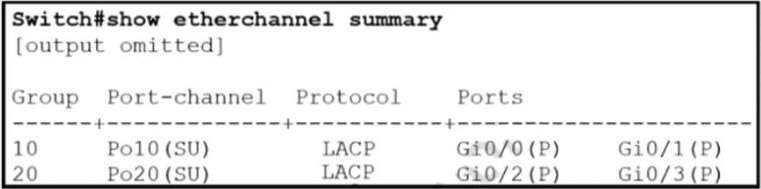
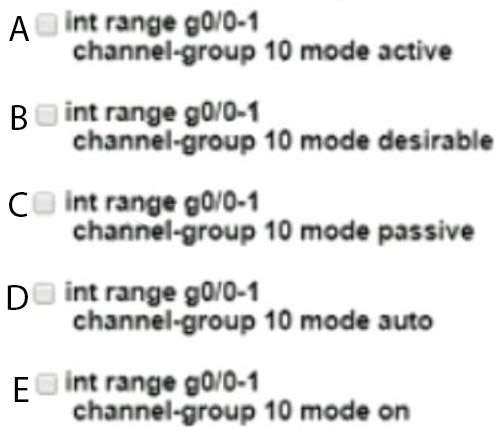
Refer to the exhibit. Which two commands were used to create port channel 10? (Choose two ) A. Option A
Choose 2 — select all that apply
BOption B
COption C
DOption D
EOption E
Correct Answer:AC
Q214(none)
What is a difference between RADIUS and TACACS+?
ARADIUS is most appropriate for dial authentication, but TACACS+ can be used for multiple types of authentication
BTACACS+ encrypts only password information and RADIUS encrypts the entire payload
CTACACS+ separates authentication and authorization, and RADIUS merges them
DRADIUS logs all commands that are entered by the administrator, but TACACS+ logs only start, stop, and interim commands
Correct Answer:C
Q215(none)
Refer to the exhibit. How does the router manage traffic to 192.168.12.16?
AIt selects the RIP route because it has the longest prefix inclusive of the destination address.
BIt chooses the OSPF route because it has the longest prefix inclusive of the destination address.
CIt load-balances traffic between all three routes
DIt chooses the EIGRP route because it has the lowest administrative distance