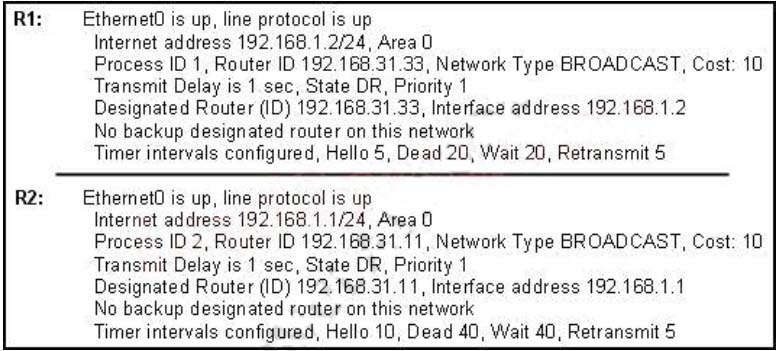
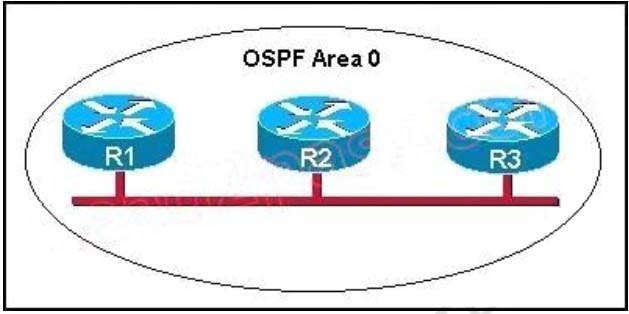
Refer to the graphic. R1 is unable to establish an OSPF neighbor relationship with R3. What are possible reasons for this problem? (Choose two.) A. All of the routers need to be configured for backbone Area 1.
Choose 2 — select all that apply
BR1 and R2 are the DR and BDR, so OSPF will not establish neighbor adjacency with R3.
CA static route has been configured from R1 to R3 and prevents the neighbor adjacency from being established.
DThe hello and dead interval timers are not set to the same values on R1 and R3.
EEIGRP is also configured on these routers with a lower administrative distance. F. R1 and R3 are configured in different areas.
Correct Answer:DF
This question is to examine the conditions for OSPF to create neighborhood. So as to make the two routers become neighbors, each router must be matched with the following items: 1. The area ID and its types; 2. Hello and failure time interval timer; 3. OSPF Password (Optional);
Q196(none)
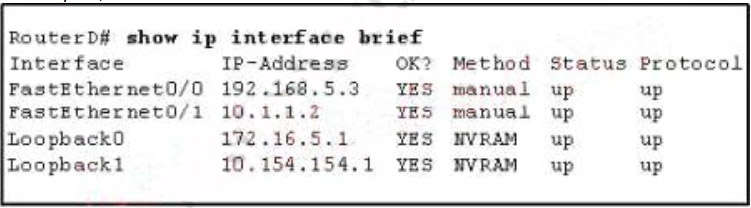
Refer to the exhibit. Given the output for this command, if the router ID has not been manually set, what router ID will OSPF use for this router? A. 10.1.1.2
B10.154.154.1
C172.16.5.1
D192.168.5.3
Correct Answer:C
The highest IP address of all loopback interfaces will be chosen -> Loopback 0 will be chosen as the router ID.
Q197(none)
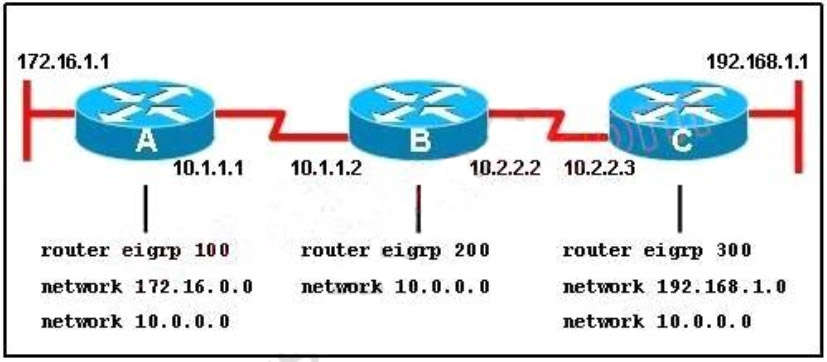
Refer to the exhibit. When running EIGRP, what is required for RouterA to exchange routing updates with RouterC?
AAS numbers must be changed to match on all the routers
BLoopback interfaces must be configured so a DR is elected
CThe no auto-summary command is needed on Router A and Router C
DRouter B needs to have two network statements, one for each connected network
Correct Answer:A
This question is to examine the understanding of the interaction between EIGRP routers. The following information must be matched so as to create neighborhood. EIGRP routers to establish, must match the following information: 1. AS Number; 2. K value.
Q198(none)
Refer to the exhibit. Which rule does the DHCP server use when there is an IP address conflict? A. The address is removed from the pool until the conflict is resolved.
BThe address remains in the pool until the conflict is resolved.
COnly the IP detected by Gratuitous ARP is removed from the pool.
DOnly the IP detected by Ping is removed from the pool.
EThe IP will be shown, even after the conflict is resolved.
Correct Answer:A
An address conflict occurs when two hosts use the same IP address. During address assignment, DHCP checks for conflicts using ping and gratuitous ARP. If a conflict is detected, the address is removed from the pool. The address will not be assigned until the administrator resolves the conflict.
Q199(none)
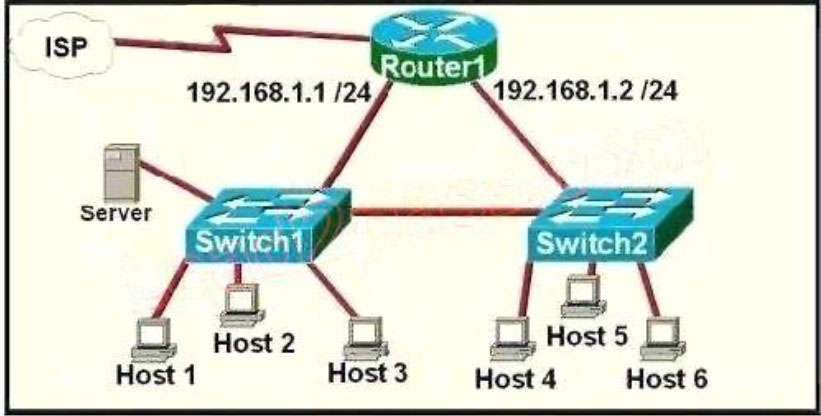
Refer to the exhibit. A network technician is asked to design a small network with redundancy. The exhibit represents this design, with all hosts configured in the same VLAN. What conclusions can be made about this design?
AThis design will function as intended.
BSpanning-tree will need to be used.
CThe router will not accept the addressing scheme. D. The connection between switches should be a trunk.
EThe router interfaces must be encapsulated with the 802.1Q protocol.
Correct Answer:C
Each interface on a router must be in a different network. If two interfaces are in the same network, the router will not accept it and show error when the administrator assigns it.
Q200(none)
What benefit does controller-based networking provide versus traditional networking?
Amoves from a two-tier to a three-tier network architecture to provide maximum redundancy
Bprovides an added layer of security to protect from DDoS attacks
Callows configuration and monitoring of the network from one centralized point
Dcombines control and data plane functionality on a single device to minimize latency
Correct Answer:C
Q201(none)
A network engineer must create a diagram of a multivendor network. Which command must be configured on the Cisco devices so that the topology of the network can be mapped?
ADevice(Config)#lldp run
BDevice(Config)#cdp run
CDevice(Config-if)#cdp enable
DDevice(Config)#flow-sampler-map topology
Correct Answer:A
Q202(none)
What are two descriptions of three-tier network topologies? (Choose two)
Choose 2 — select all that apply
AThe core and distribution layers perform the same functions
BThe access layer manages routing between devices in different domains
CThe network core is designed to maintain continuous connectivity when devices fail.
DThe core layer maintains wired connections for each host
EThe distribution layer runs Layer 2 and Layer 3 technologies
Correct Answer:CE
Q203(none)
What is the expected outcome when an EUI-64 address is generated?
AThe seventh bit of the original MAC address of the interface is inverted
BThe interface ID is configured as a random 64-bit value
CThe characters FE80 are inserted at the beginning of the MAC address of the interface
DThe MAC address of the interface is used as the interface ID without modification
Correct Answer:A
Q204(none)
Which function does an SNMP agent perform?
Ait sends information about MIB variables in response to requests from the NMS
Bit coordinates user authentication between a network device and a TACACS+ or RADIUS server
Cit requests information from remote network nodes about catastrophic system events.
Dit manages routing between Layer 3 devices in a network