Which statement about Cisco Discovery Protocol is true?
AIt is a Cisco-proprietary protocol.
BIt runs on the network layer.
CIt can discover information from routers, firewalls, and switches.
DIt runs on the physical layer and the data link layer.
Correct Answer:A
Q184(none)
Which value can you modify to configure a specific interface as the preferred forwarding interface?
AThe interface number
BThe port priority
CThe VLAN priority
DThe hello time
Correct Answer:B
Q185(none)
When configuring an EtherChannel bundle, which mode enables LACP only if a LACP device is detected?
APassive
BDesirable
COn
DAuto
EActive
Correct Answer:A
The LACP is Link Aggregation Control Protocol. LACP is an open protocol, published under the 802.3ad. The modes of LACP are active, passive or on. The side configured as "pasive" will waiting the other side that should an Active for the Etherchannel to be established. PAgP is Port-Aggregation Protocol. It is Cisco proprietary protocol. The mode are On, Desirable or Auto. Desirable - Auto will establish a EtherChannel. An example of how to configure an Etherchannel: SwitchFormula1>enable SwitchFormula1#configure terminal SwitchFormula1(config)# interface range f0/5 -14 SwitchFormula1(config-i
Q186(none)
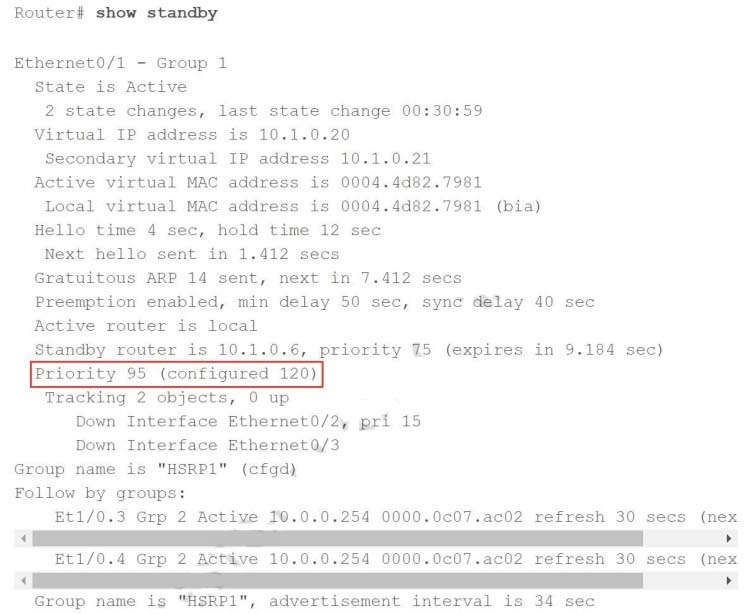
Which command should you enter to verify the priority of a router in an HSRP group?
Ashow hsrp
Bshow sessions
Cshow interfaces
Dshow standby
Correct Answer:D
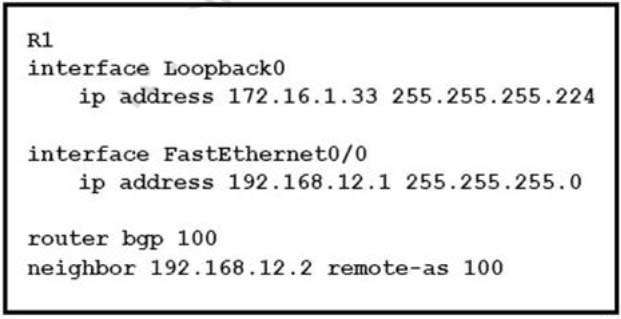
The following is sample output from the show standby command: QUESTION 187 Refer to the exhibit. Which Command do you enter so that R1 advertises the loopback0 interface to the BGP Peers? A. Network 172.16.1.32 mask 255.255.255.224 B. Network 172.16.1.0 0.0.0.255 C. Network 172.16.1.32 255.255.255.224 D. Network 172.16.1.33 mask 255.255.255.224 E. Network 172.16.1.32 mask 0.0.0.31 F. Network 172.16.1.32 0.0.0.31 Correct Answer: A Section: (none) Explanation Explanation/Reference:
Q188(none)
For what two purposes does the Ethernet protocol use physical addresses?
Choose 2 — select all that apply
Ato uniquely identify devices at Layer 2
Bto allow communication with devices on a different network
Cto differentiate a Layer 2 frame from a Layer 3 packet
Dto establish a priority system to determine which device gets to transmit first
Eto allow communication between different devices on the same network F. to allow detection of a remote device when its physical address is unknown
Correct Answer:AE
QUESTION 189 Which command is used to display the collection of OSPF link states? A. show ip ospf link-state B. show ip ospf lsa database C. show ip ospf neighbors D. show ip ospf database Correct Answer: D Section: (none) Explanation Explanation/Reference: The “show ip ospf database” command displays the link states. Here is an example: Here is the lsa database on R2. R2#show ip ospf database OSPF Router with ID (2.2.2.2) (Process ID 1) Router Link States (Area 0) Link ID ADV Router Age Seq# Checksum Link count2.2.2.2 2.2.2.2 793 0x80000003 0x004F85 210.4.4.4 10.4.4.4 776 0x80000004 0x005643
Q190(none)
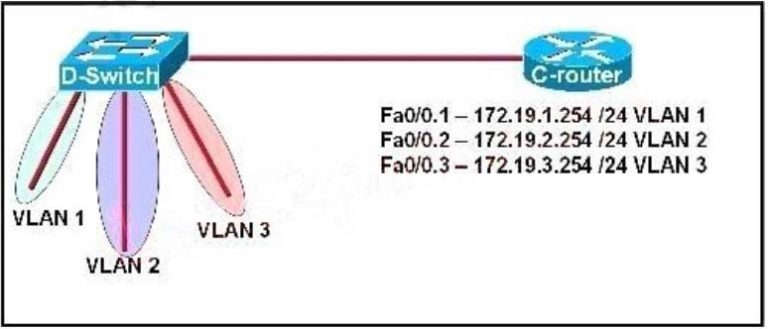
Refer to the exhibit. C-router is to be used as a “router-on-a-stick” to route between the VLANs. All the interfaces have been properly configured and IP routing is operational. The hosts in the VLANs have been configured with the appropriate default gateway. What is true about this configuration?
AThese commands need to be added to the configuration: C-router(config)# router eigrp 123 C-router(config-router)# network 172.19.0.0
BThese commands need to be added to the configuration: C-router(config)# router ospf 1 C-router(config-router)# network 172.19.0.0 0.0.3.255
CThese commands need to be added to the configuration: C-router(config)# router rip C-router(config-router)# network 172.19.0.0
DNo further routing configuration is required.
Correct Answer:D
Since all the same router (C-router) is the default gateway for all three VLANs, all traffic destined to a different VLAN will be sent to the C-router. The C-router will have knowledge of all three networks since they will appear as directly connected in the routing table. Since the C-router already knows how to get to all three networks, no routing protocols need to be configured.
Q191(none)
A user configured OSPF in a single area between two routers A serial interface connecting R1 and R2 is running encapsulation PPP. By default which OSPF network type is seen on this interface when the user types show ip ospf interface on R1 or R2?
Aport-to-multipoint
Bbroadcast
Cpoint-to-point
Dnon-broadcast
Correct Answer:C
The default OSPF network type for HDLC and PPP on Serial link is point-to-point (while the default OSPF network type for Ethernet link is Broadcast).
Q192(none)
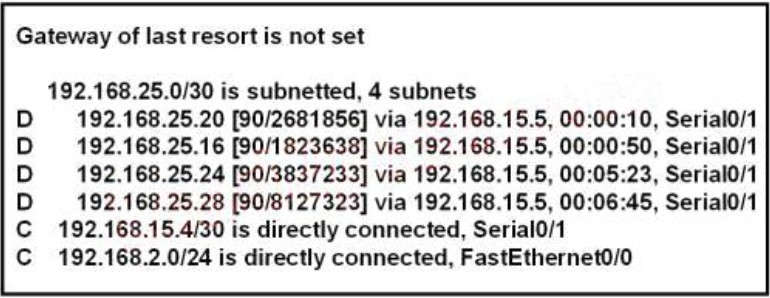
Refer to the exhibit. Which address and mask combination represents a summary of the routes learned by EIGRP?
A192.168.25.0 255.255.255.240
B192.168.25.0 255.255.255.252 C. 192.168.25.16 255.255.255.240
D192.168.25.16 255.255.255.252
E192.168.25.28 255.255.255.240 F. 192.168.25.28 255.255.255.252
Correct Answer:C
The binary version of 20 is 10100. The binary version of 16 is 10000. The binary version of 24 is 11000. The binary version of 28 is 11100. The subnet mask is /28. The mask is 255.255.255.240. Note: From the output above, EIGRP learned 4 routes and we need to find out the summary of them: + 192.168.25.16 + 192.168.25.20 + 192.168.25.24 + 192.168.25.28 -> The increment should bE. 28 ?16 = 12 but 12 is not an exponentiation of 2 so we must choose 16 (24). Therefore the subnet mask is /28 (=1111 1111.1111 1111.1111 1111.11110000) = 255.255.255.240 So the best answer should be 192.168.25.16 255.25
Q193(none)
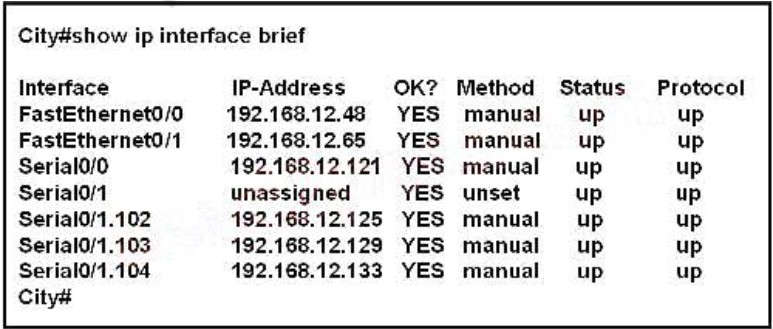
Refer to the exhibit. A network associate has configured OSPF with the command: City(config-router)# network 192.168.12.64 0.0.0.63 area 0. After completing the configuration, the associate discovers that not all the interfaces are participating in OSPF. Which three of the interfaces shown in the exhibit will participate in OSPF according to this configuration statement? (Choose three.)
Choose 3 — select all that apply
AFastEthernet0 /0
BFastEthernet0 /1
CSerial0/0
DSerial0/1.102
ESerial0/1.103 F. Serial0/1.104
Correct Answer:BCD
The “network 192.168.12.64 0.0.0.63 equals to network 192.168.12.64/26. This network has: + Increment: 64 (/26= 1111 1111.1111 1111.1111 1111.1100 0000) + Network address: 192.168.12.64 + Broadcast address: 192.168.12.127 Therefore all interface in the range of this network will join OSPF.
Q194(none)
A network administrator is troubleshooting the OSPF configuration of routers R1 and R2. The routers cannot establish an adjacency relationship on their common Ethernet link. The graphic shows the output of the show ip ospf interface e0 command for routers R1 and R2. Based on the information in the graphic, what is the cause of this problem?
AThe OSPF area is not configured properly.
BThe OSPF area is not configured properly.
CThe cost on R1 should be set higher.
DThe hello and dead timers are not configured properly.
EA backup designated router needs to be added to the network. F. The OSPF process ID numbers must match.