You have configured a router with an OSPF router ID, but its IP address still reflects the physical interface. Which action can you take to correct the problem in the least disruptive way?
AReload the OSPF process.
BSpecify a loopback address
CReboot the router.
DSave the router configuration
Correct Answer:A
Once an OSPF Router ID selection is done, it remains there even if you remove it or configure another OSPF Router ID. So the least disruptive way is to correct it using the command "clear ip ospf process".
Q164(none)
Which two statements about VTP are true? (Choose two.)
Choose 2 — select all that apply
AAll switches must be configured with the same VTP domain name
BAll switches must be configured to perform trunk negotiation.
CAll switches must be configured with a unique VTP domain name
DThe VTP server must have the highest revision number in the domain
Which two pieces of information about a Cisco device can Cisco Discovery Protocol communicate? (Choose two.)
Choose 2 — select all that apply
Athe native VLAN
Bthe trunking protocol
Cthe VTP domain D. the spanning-tree priority
Ethe spanning tree protocol
Correct Answer:AC
Q166(none)
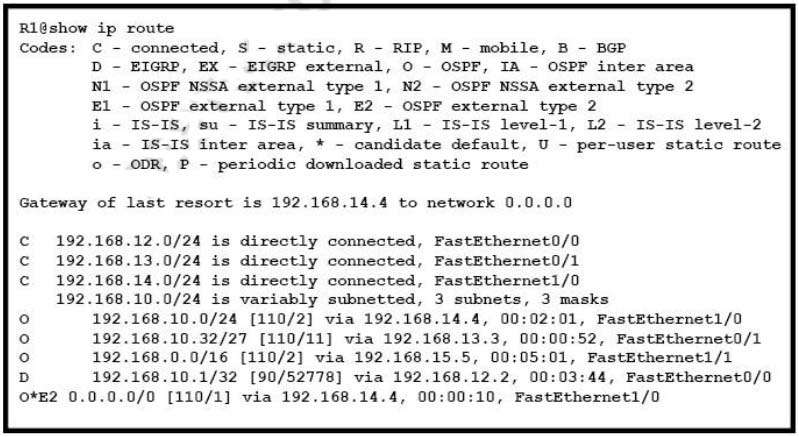
Refer to the exhibit. On R1 which routing protocol is in use on the route to 192.168.10.1?
ARIP
BOSPF
CIGRP
DEIGRP
Correct Answer:D
Q167(none)
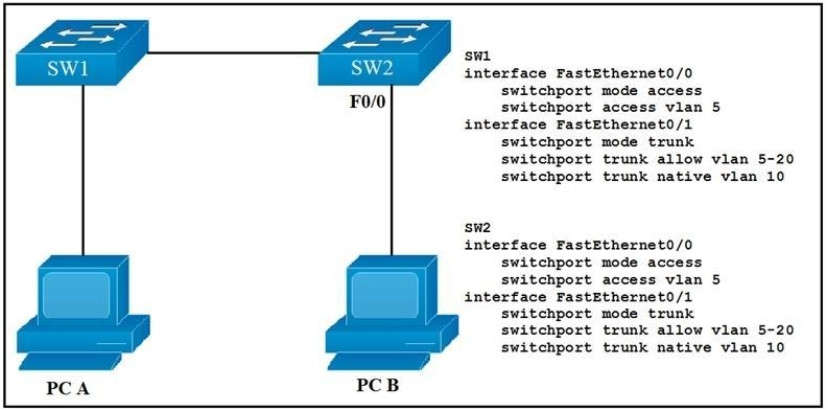
Refer to the exhibit. Which VLAN ID is associated with the default VLAN in the given environment? A. VLAN 1
BVLAN 5
CVLAN 10
DVLAN 20
Correct Answer:A
Q168(none)
Which two circumstances can prevent two routers from establishing an OSPF neighbor adjacency? (Choose two.)
Choose 2 — select all that apply
Amismatched autonomous system numbers
Ban ACL blocking traffic from multicast address 224.0.0.10
Cmismatched process IDs
Dmismatched hello timers and dead timers
Euse of the same router ID on both devices
Correct Answer:DE
Q169(none)
Which two statements about eBGP neighbor relationships are true? (Choose two) A. The two devices must reside in different autonomous systems
Choose 2 — select all that apply
BNeighbors must be specifically declared in the configuration of each device
CThey can be created dynamically after the network statement is configured.
DThe two devices must reside in the same autonomous system
EThe two devices must have matching timer settings
Correct Answer:AB
Q170(none)
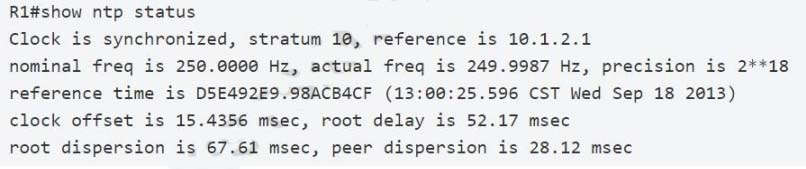
Which two pieces of information can you determine from the output of the show ntp status command? (Choose two)
Choose 2 — select all that apply
Awhether the NTP peer is statically configured
Bthe IP address of the peer to which the clock is synchronized
Cthe configured NTP servers
Dwhether the clock is synchronized
Ethe NTP version number of the peer
Correct Answer:BD
Below is the output of the "show ntp status" command. From this output we learn that R1 has a stratum of 10 and it is getting clock from 10.1.2.1.
Q171(none)
Which keyword in a NAT configuration enables the use of one outside IP address for multiple inside hosts?
Asource
Bstatic
Cpool
Doverload
Correct Answer:D
By adding the keyword "overload" at the end of a NAT statement, NAT becomes PAT (Port Address Translation). This is also a kind of dynamic NAT that maps multiple private IP addresses to a single public IP address (many-to-one) by using different ports. Static NAT and Dynamic NAT both require a one-to-one mapping from the inside local to the inside global address. By using PAT, you can have thousands of users connect to the Internet using only one real global IP address. PAT is the technology that helps us not run out of public IP address on the Internet. This is the most popular type of NAT.
Q172(none)
Which two pieces of information can you learn by viewing the routing table? (Choose two)
Choose 2 — select all that apply
Awhether an ACL was applied inbound or outbound to an interface
Bthe EIGRP or BGP autonomous system
Cwhether the administrative distance was manually or dynamically configured