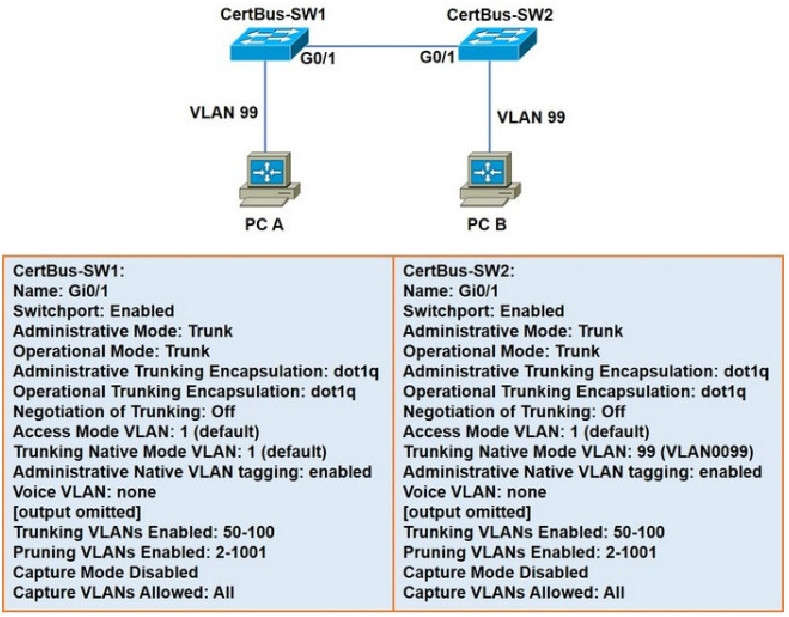
Refer to the Exhibit. After the switch configuration the ping test fails between PC A and PC B Based on the output for switch 1. Which error must be corrected?
AThere is a native VLAN mismatch.
BAccess mode is configured on the switch ports.
CThe PCs are in the incorrect VLAN.
DAll VLANs are not enabled on the trunk.
Correct Answer:A
From the output we see the native VLAN of Switch1 on Gi0/1 interface is VLAN 1 while that of Switch2 is VLAN 99 so there would be a native VLAN mismatch.
Q895. Security Fundamentals
An engineer must configure a WLAN using the strongest encryption type for WPA2-PSK. Which cipher fulfills the configuration requirement?
AWEP B. RC4
CAES
DTKIP
Correct Answer:C
Many routers provide WPA2-PSK (TKIP), WPA2-PSK (AES), and WPA2-PSK (TKIP/AES) as options. TKIP is actually an older encryption protocol introduced with WPA to replace the very-insecure WEP encryption at the time. TKIP is actually quite similar to WEP encryption. TKIP is no longer considered secure, and is now deprecated. In other words, you shouldn't be using it. AES is a more secure encryption protocol introduced with WPA2 and it is currently the strongest encryption type for WPA2-PSK/
Q902. Network Access
Which statement about Link Aggregation when implemented on a Cisco Wireless LAN Controller is true?
ATo pass client traffic two or more ports must be configured.
BThe EtherChannel must be configured in “mode active”.
CWhen enabled, the WLC bandwidth drops to 500 Mbps.
DOne functional physical port is needed to pass client traffic.
Correct Answer:D
Link aggregation (LAG) is a partial implementation of the 802.3ad port aggregation standard. It bundles all of the controller's distribution system ports into a single 802.3ad port channel. Restriction for Link aggregation: - LAG requires the EtherChannel to be configured for `mode on' on both the controller and the Catalyst switch > Answer B is not correct. - If the recommended load-balancing method cannot be configured on the Catalyst switch, then configure the LAG connection as a single member link or disable LAG on the controller -> Answer A is not correct while answer D is correct. Refere
Q915. Security Fundamentals
When configuring a WLAN with WPA2 PSK in the Cisco Wireless LAN Controller GUI, which two formats are available to select? (Choose two)
Choose 2 — select all that apply
AASCII
Bbase64
Cbinary
Ddecimal
Ehexadecimal
Correct Answer:AE
When configuring a WLAN with WPA2 Preshared Key (PSK), we can choose the encryption key format as either ASCII or HEX. Reference: https://www.cisco.com/c/en/us/td/docs/wireless/controller/7-4/configuration/guides/consolidated/b_cg74_CONSOLIDATED/b_cg74_CONSOLIDATED_chapter_01010001.html
Q926. Automation and Programmability
Which API is used in controller-based architectures to interact with edge devices?
Aoverlay
Bnorthbound
Cunderlay
Dsouthbound
Correct Answer:D
Q93Not categorized
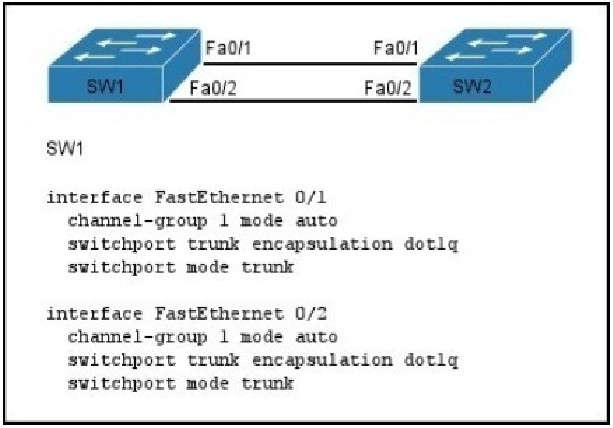
Refer to the exhibit. A network administrator is configuring an EtherChannel between SW1 and SW2. The SW1 configuration is shown. What is the correct configuration for SW2?
If the etherchannel was configured with mode “auto”, it was using PagP, so, we need to configure the other switch with “desirable” mode. PagP modes: auto | Desirable LACP modes: active | pasive
Q94Not categorized
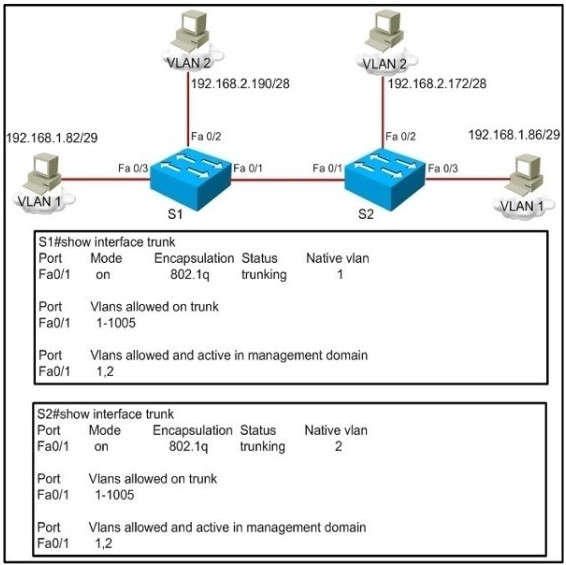
Refer to the exhibit. A frame on VLAN 1 on switch S1 is sent to switch S2 where the frame is received on VLAN 2. What causes this behavior?
Atrunk mode mismatches
Ballowing only VLAN 2 on the destination
Cnative VLAN mismatches
DVLANs that do not correspond to a unique IP subnet
Correct Answer:C
Untagged frames are encapsulated with the native VLAN. In this case, the native VLANs are different so although S1 will tag it as VLAN 1 it will be received by S2.
Q95Not categorized
What are two enhancements that OSPFv3 supports over OSPFV2? (Choose two.)
Choose 2 — select all that apply
AIt requires the use of ARP.
BIt can support multiple IPv6 subnets on a single link. C. It supports up to 2 instances of OSPFv3 over a common link.
DIt routes over links rather than over networks.
Correct Answer:BD
Q96Not categorized
Which option is a valid IPv6 address?
A2001:0000:130F::099a::12a
B2002:7654:A1AD:61:81AF:CCC1
CFEC0:ABCD:WXYZ:0067::2A4
D2004:1:25A4:886F::1
Correct Answer:D
An IPv6 address is represented as eight groups of four hexadecimal digits, each group representing 16 bits (two octets). The groups are separated by colons (:). An example of an IPv6 address is 2001:0db8:85a3:0000:0000:8a2e:0370:7334. The leading 0’s in a group can be collapsed using ::, but this can only be done once in an IP address.
Q97Not categorized
Which three are characteristics of an IPv6 anycast address? (Choose three.)
Choose 3 — select all that apply
Aone-to-many communication model
Bone-to-nearest communication model
Cany-to-many communication model
Da unique IPv6 address for each device in the group
Ethe same address for multiple devices in the group F. delivery of packets to the group interface that is closest to the sending device
Correct Answer:BEF
A new address type made specifically for IPv6 is called the Anycast Address. These IPv6 addresses are global addresses, these addresses can be assigned to more than one interface unlike an IPv6 unicast address. Anycast is designed to send a packet to the nearest interface that is a part of that anycast group. The sender creates a packet and forwards the packet to the anycast address as the destination address which goes to the nearest router. The nearest router or interface is found by using the metric of a routing protocol currently running on the network. However in a LAN setting the nearest