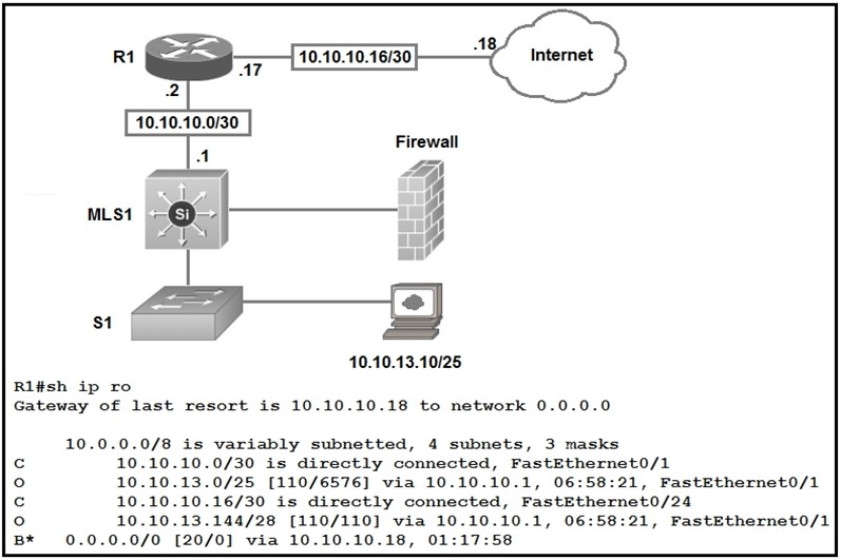
Refer to the exhibit. Which type of route does R1 use to reach host 10.10.13.10/32?
Afloating static route
Bhost route
Cdefault route
Dnetwork route
Correct Answer:D
From the output, we see R1 will use the entry "O 10.10.13.0/25 [110/4576] via 10.10.10.1, ..." to reach host 10.10.13.10. This is a network route. Note: "B* 0.0.0.0/0 ..." is a default route.
Q555. Security Fundamentals
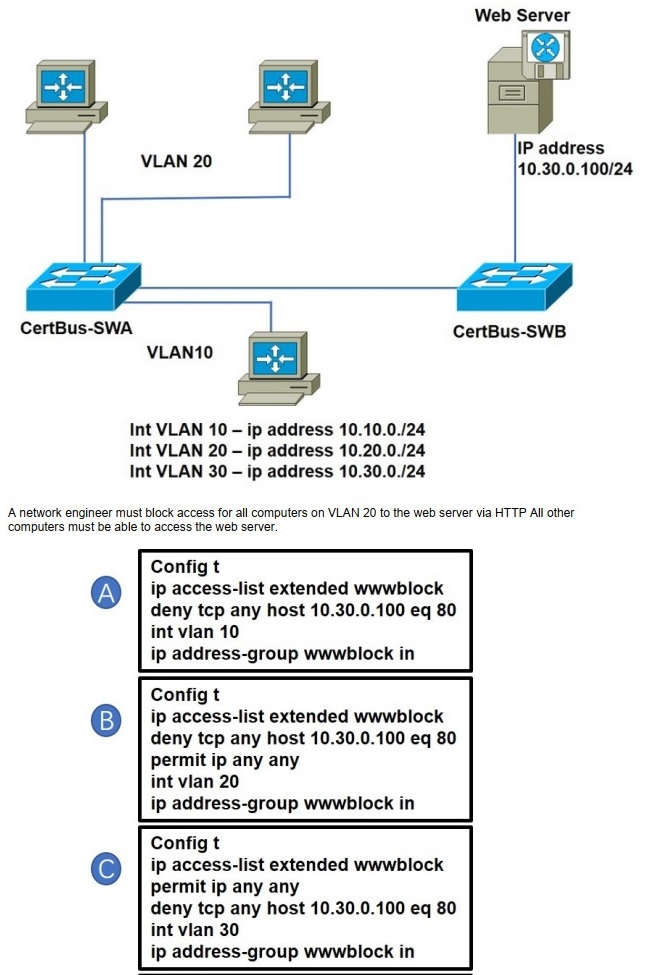
Refer to the exhibit. Which configuration when applied to switch A accomplishes this task? A. Option A
BOption B
COption C
DOption D
Correct Answer:B
Q562. Network Access
Two switches are connected and using Cisco Dynamic Trunking Protocol SW1 is set to Dynamic Desirable. What is the result of this configuration?
AThe link is in a down state.
BThe link is in an error disables state
CThe link is becomes an access port.
DThe link becomes a trunk port.
Correct Answer:D
Q575. Security Fundamentals
Which feature on the Cisco Wireless LAN Controller when enabled restricts management access from specific networks?
ACPU ACL
BTACACS
CFlex ACL
DRADIUS
Correct Answer:A
Whenever you want to control which devices can talk to the main CPU, a CPU ACL is used. Note: CPU ACLs only filter traffic towards the CPU, and not any traffic exiting or generated by the CPU. Reference: https://www.cisco.com/c/en/us/support/docs/wireless-mobility/wlan-security/71978-acl-wlc.html
Q583. IP Connectivity
A user configured OSPF in a single area between two routers A serial interface connecting R1 and R2 is running encapsulation PPP, by default, which OSPF network type is seen on this interface when the user types show ip ospf interface on R1 or R2?
Aport-to-multipoint
Bbroadcast
Cpoint-to-point D. nonbroadcast
Correct Answer:C
The default OSPF network type for HDLC and PPP on Serial link is point-to-point (while the default OSPF network type for Ethernet link is Broadcast).
Q592. Network Access
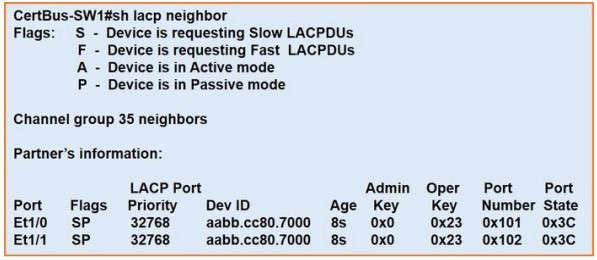
Refer to the exhibit. Based on the LACP neighbor status, in which mode is the SW1 port channel configured?
Apassive
Bmode on
Cauto
Dactive
Correct Answer:D
From the neighbor status, we notice the “Flags” are SP. “P” here means the neighbor is in Passive mode. In order to create an Etherchannel interface, the (local) SW1 ports should be in Active mode. Moreover, the “Port State” in the exhibit is “0x3c” (which equals to “00111100 in binary format). Bit 3 is “1” which means the ports are synchronizing -> the ports are working so the local ports should be in Active mode.
Q603. IP Connectivity
A user configured OSPF and advertised the Gigabit Ethernet interface in OSPF by default, which type of OSPF network does this interface belong to?
Apoint-to-multipoint
Bpoint-to-point
Cbroadcast
Dnonbroadcast
Correct Answer:C
The Broadcast network type is the default for an OSPF enabled ethernet interface (while Point-toPoint is the default OSPF network type for Serial interface with HDLC and PPP encapsulation). Reference: https://www.oreilly.com/library/view/cisco-ios-cookbook/0596527225/ch08s15.html
Q616. Automation and Programmability
An organization has decided to start using cloud-provided services. Which cloud service allows the organization to install its own operating system on a virtual machine?
Aplatform-as-a-service
Bsoftware-as-a-service
Cnetwork-as-a-service
Dinfrastructure-as-a-service
Correct Answer:D
Below are the 3 cloud supporting services cloud providers provide to customer: + SaaS (Software as a Service): SaaS uses the web to deliver applications that are managed by a thirdparty vendor and whose interface is accessed on the clients' side. Most SaaS applications can be run directly from a web browser without any downloads or installations required, although some require plugins. + PaaS (Platform as a Service): are used for applications, and other development, while providing cloud components to software. What developers gain with PaaS is a framework they can build upon to develop or cus
Q622. Network Access
Which mode allows access points to be managed by Cisco Wireless LAN Controllers?
Aautonomous
Blightweight
Cbridge
Dmobility express
Correct Answer:B
A Lightweight Access Point (LAP) is an AP that is designed to be connected to a wireless LAN (WLAN) controller (WLC). APs are “lightweight,” which means that they cannot act independently of a wireless LAN controller (WLC). The WLC manages the AP configurations and firmware. The APs are “zero touch” deployed, and individual configuration of APs is not necessary. Click hereClick here QUESTION 63 Which command automatically generates an IPv6 address from a specified IPvô prefix and MAC address of an interface? A. ipv6 address dhcp B. ipv6 address 2001:DB8:5:112::/64 eui-64 C. ipv6 address autoco
Q643. IP Connectivity
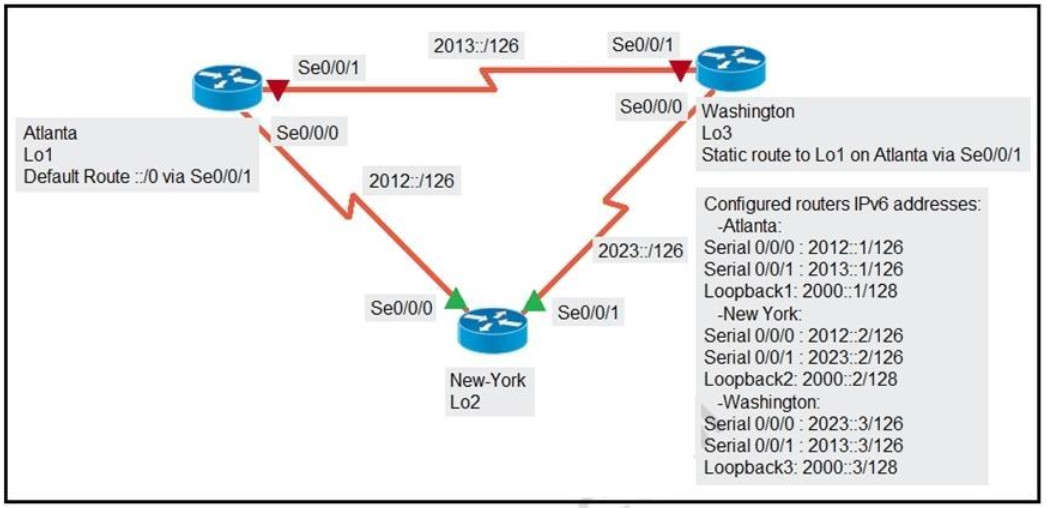
Refer to Exhibit. An engineer is configuring the NEW York router to reach the Lot interface of the Atlanta router using interface Se0/0/0 as the primary path. Which two commands must be configured on the New York router so that it can reach the Lo1 interface of the Atlanta router via Washington when the link between New York and Atlanta goes down? (Choose two)
Choose 2 — select all that apply
Aipv6 router 2000::1/128 2012::1
Bipv6 router 2000::1/128 2012:1 5 C. ipv6 router 2000::1/128 2012::2
Dipv6 router 2000::1/128 2023:2 5
Eipv6 router 2000::1/128 2023::3 5
Correct Answer:AE
Floating static routes are static routes that have an administrative distance greater than the administrative distance (AD) of another static route or dynamic routes. By default a static route has an AD of 1 then floating static route must have the AD greater than 1. Floating static route has a manually configured administrative distance greater than that of the primary route and therefore would not be in the routing table until the primary route fails.