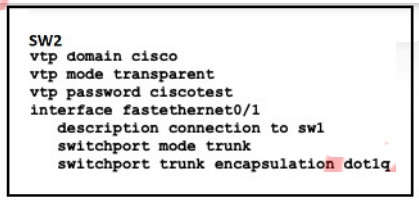
Refer to Exhibit. How does SW2 interact with other switches in this VTP domain?
AIt processes VTP updates from any VTP clients on the network on its access ports.
BIt receives updates from all VTP servers and forwards all locally configured VLANs out all trunk ports.
CIt forwards only the VTP advertisements that it receives on its trunk ports.
DIt transmits and processes VTP updates from any VTP Clients on the network on its trunk ports.
Correct Answer:C
The VTP mode of SW2 is transparent so it only forwards the VTP updates it receives to its trunk links without processing them. Reference: https://www.cisco.com/c/en/us/support/docs/lan-switching/vtp/10558-21.html
Q342. Network Access
Which unified access point mode continues to serve wireless clients after losing connectivity to the Cisco Wireless LAN Controller?
Which two encoding methods are supported by REST APIs? (Choose two)
Choose 2 — select all that apply
AYAML
BJSON
CEBCDIC
DSGML
EXML
Correct Answer:BE
The Application Policy Infrastructure Controller (APIC) REST API is a programmatic interface that uses REST architecture. The API accepts and returns HTTP (not enabled by default) or HTTPS messages that contain JavaScript Object Notation (JSON) or Extensible Markup Language (XML) documents. Reference: https://www.cisco.com/c/en/us/td/docs/switches/datacenter/nexus1000/sw/5_x/rest_api_config/b_Cisco_N1KV_VMware_REST_API_Config_5x/ b_Cisco_N1KV_VMware_REST_API_Config_5x_chapter_010.pdf
Q361. Network Fundamentals
What are two reasons that cause late collisions to increment on an Ethernet interface? (Choose two)
Choose 2 — select all that apply
Awhen the sending device waits 15 seconds before sending the frame again
Bwhen the cable length limits are exceeded
Cwhen one side of the connection is configured for half-duplex
Dwhen Carner Sense Multiple Access/Collision Detection is used
Ewhen a collision occurs after the 32nd byte of a frame has been transmitted
Correct Answer:BC
A late collision is defined as any collision that occurs after the first 512 bits (or 64th byte) of the frame have been transmitted. The usual possible causes are full-duplex/half-duplex mismatch, exceeded Ethernet cable length limits, or defective hardware such as incorrect cabling, noncompliant number of hubs in the network, or a bad NIC. Late collisions should never occur in a properly designed Ethernet network. They usually occur when Ethernet cables are too long or when there are too many repeaters in the network. Reference: Click here
Q373. IP Connectivity
Router A learns the same route from two different neighbors, one of the neighbor routers is an OSPF neighbor and the other is an EIGRP neighbor. What is the administrative distance of the route that will be installed in the routing table?
A20
B90
C110
D115
Correct Answer:B
The Administrative distance (AD) of EIGRP is 90 while the AD of OSPF is 110 so EIGRP route will be chosen to install into the routing table.
Q382. Network Access
What is the primary effect of the spanning-tree portfast command?
AIt enables BPDU messages
BIt minimizes spanning-tree convergence time
CIt immediately puts the port into the forwarding state when the switch is reloaded
DIt immediately enables the port in the listening state
What is the default behavior of a Layer 2 switch when a frame with an unknown destination MAC address is received?
AThe Layer 2 switch drops the received frame.
BThe Layer 2 switch floods packets to all ports except the receiving port in the given VLAN.
CThe Layer 2 switch sends a copy of a packet to CPU for destination MAC address learning.
DThe Layer 2 switch forwards the packet and adds the destination MAC address to its MAC address table.
Correct Answer:B
If the destination MAC address is not in the CAM table (unknown destination MAC address), the switch sends the frame out all other ports that are in the same VLAN as the received frame. This is called flooding. It does not flood the frame out the same port on which the frame was received.
Q405. Security Fundamentals
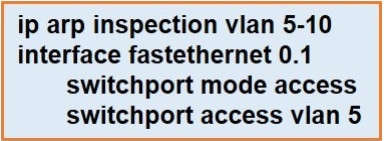
Refer to the exhibit. What is the effect of this configuration? A. All ARP packets are dropped by the switch.
BEgress traffic is passed only if the destination is a DHCP server.
CAll ingress and egress traffic is dropped because the interface is untrusted.
DThe switch discard all ingress ARP traffic with invalid MAC-to-IP address bindings.
Correct Answer:D
Dynamic ARP inspection is an ingress security feature; it does not perform any egress checking.
Q414. IP Services
Refer to the exhibit. An engineer configured NAT translations and has verified that the configuration is correct. Which IP address is the source IP?
A10.4.4.4
B10.4.4.5
C172.23.103.10
D172.23.104.4
Correct Answer:D
Q423. IP Connectivity
Refer to the exhibit. Which route does R1 select for traffic that is destined to 192 168.16.2? A. 192.168.16.0/21
B192.168.16.0/24
C192.168 26.0/26
D192.168.16.0/27
Correct Answer:D
The destination IP addresses match all four entries in the routing table but the 192.168.16.0/27 has the longest prefix so it will be chosen. This is called the "longest prefix match" rule.