An email user has been lured into clicking a link in an email sent by their company’s security organization. The webpage that opens reports that it was safe but the link could have contained malicious code. Which type of security program is in place?
APhysical access control
BSocial engineering attack
Cbrute force attack
Duser awareness
Correct Answer:D
This is a training program which simulates an attack, not a real attack (as it says “The webpage that opens reports that it was safe”) so we believed it should be called a “user awareness” program. Therefore the best answer here should be “user awareness”. This is the definition of “User awareness” from CCNA 200- 301 Offical Cert Guide Book: “User awareness: All users should be made aware of the need for data confidentiality to protect corporate information, as well as their own credentials and personal information. They should also be made aware of potential threats, schemes to mislead, and p
Q125. Security Fundamentals
Which type of wireless encryption is used for WPA2 in pre-shared key mode?
ATKIP with RC4
BRC4
CAES-128
DAES-256
Correct Answer:D
We can see in this picture we have to type 64 hexadecimal characters (256 bit) for the WPA2 passphrase so we can deduce the encryption is AES-256, not AES-128. Reference: https://www.cisco.com/c/en/us/support/docs/wireless-mobility/wireless-lan-wlan/67134-wpa2config.html
Q14Not categorized
Which type of address is the public IP address of a NAT device?
Aoutside global
Boutsdwde local
Cinside global
Dinsride local
Eoutside public F. inside public
Correct Answer:C
NAT use four types of addresses: * Inside local address - The IP address assigned to a host on the inside network. The address is usually not an IP address assigned by the Internet Network Information Center (InterNIC) or service provider. This address is likely to be an RFC 1918 private address. * Inside global address - A legitimate IP address assigned by the InterNIC or service provider that represents one or more inside local IP addresses to the outside world. * Outside local address - The IP address of an outside host as it is known to the hosts on the inside network. * Outside global add
Q151. Network Fundamentals
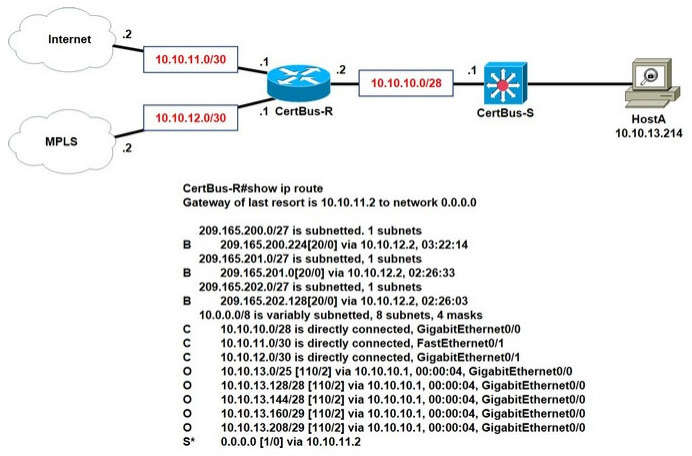
Refer to the exhibit. Which prefix does Router 1 use for traffic to Host A? A. 10.10.10.0/28
B10.10.13.0/25
C10.10.13.144/28
D10.10.13.208/29
Correct Answer:D
Host A address fall within the address range. However, if more than one route to the same subnet exist (router will use the longest stick match, which match more specific route to the subnet). If there are route 10.10.13.192/26 and 10.10.13.208/29, the router will forward the packet to /29 rather than /28.
Q163. IP Connectivity
How does HSRP provide first hop redundancy?
AIt load-balances traffic by assigning the same metric value to more than one route to the same destination m the IP routing table.
BIt load-balances Layer 2 traffic along the path by flooding traffic out all interfaces configured with the same VLAN.
CIt forwards multiple packets to the same destination over different routed links n the data path.
DIt uses a shared virtual MAC and a virtual IP address to a group of routers that serve as the default gateway for hosts on a LAN.
In Which way does a spine-and-leaf architecture allow for scalability in a network when additional access ports are required?
AA spine switch and a leaf switch can be added with redundant connections between them.
BA spine switch can be added with at least 40 GB uplinks.
CA leaf switch can be added with a single connection to a core spine switch.
DA leaf switch can be added with connections to every spine switch.
Correct Answer:D
Spine-leaf architecture is typically deployed as two layers: spines (such as an aggregation layer), and leaves (such as an access layer). Spine-leaf topologies provide high-bandwidth, low-latency, nonblocking server-toserver connectivity. Leaf (aggregation) switches are what provide devices access to the fabric (the network of spine and leaf switches) and are typically deployed at the top of the rack. Generally, devices connect to the leaf switches. Devices can include servers, Layer 4-7 services (firewalls and load balancers), and WAN or Internet routers. Leaf switches do not connect to other
Q184. IP Services
Which two actions are performed by the Weighted Random Early Detection mechanism? (Choose two)
Choose 2 — select all that apply
AIt drops lower-priority packets before it drops higher-priority packets.
BIt can identify different flows with a high level of granularity.
CIt guarantees the delivery of high-priority packets.
DIt can mitigate congestion by preventing the queue from filling up.
EIt supports protocol discovery.
Correct Answer:AD
Weighted Random Early Detection (WRED) is just a congestion avoidance mechanism. WRED drops packets selectively based on IP precedence. Edge routers assign IP precedences to packets as they enter the network. When a packet arrives, the following events occur: 1. The average queue size is calculated. 2. If the average is less than the minimum queue threshold, the arriving packet is queued. 3. If the average is between the minimum queue threshold for that type of traffic and the maximum threshold for the interface, the packet is either dropped or queued, depending on the packet drop probability
Q194. IP Services
A network engineer must back up 20 network router configurations globally within a customer environment. Which protocol allows the engineer to perform this function using the Cisco IOS MIB?
ACDP
BSNMP
CSMTP
DARP
Correct Answer:B
SNMP is an application-layer protocol that provides a message format for communication between SNMP managers and agents. SNMP provides a standardized framework and a common language used for the monitoring and management of devices in a network. The SNMP framework has three parts: + An SNMP manager + An SNMP agent + A Management Information Base (MIB) The Management Information Base (MIB) is a virtual information storage area for network management information, which consists of collections of managed objects. With SNMP, the network administrator can send commands to multiple routers to do the
Q205. Security Fundamentals
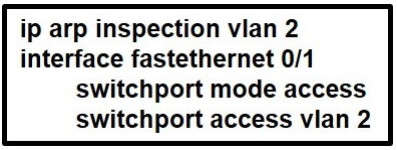
Refer to the exhibit. What is the effect of this configuration?
AThe switch port interface trust state becomes untrusted.
BThe switch port remains administratively down until the interface is connected to another switch.
CDynamic ARP inspection is disabled because the ARP ACL is missing.
DThe switch port remains down until it is configured to trust or untrust incoming packets.
Correct Answer:A
Dynamic ARP inspection (DAI) is a security feature that validates ARP packets in a network. It intercepts, logs, and discards ARP packets with invalid IP-to-MAC address bindings. This capability protects the network from certain man-in-the-middle attacks. After enabling DAI, all ports become untrusted ports.
Q211. Network Fundamentals
A frame that enters a switch fails the Frame Check Sequence. Which two interface counters are incremented? (Choose two) A. runts
Choose 2 — select all that apply
Bgiants
Cframe
DCRC
Einput errors
Correct Answer:DE
Whenever the physical transmission has problems, the receiving device might receive a frame whose bits have changed values. These frames do not pass the error detection logic as implemented in the FCS field in the Ethernet trailer. The receiving device discards the frame and counts it as some kind of input error. Cisco switches list this error as a CRC error. Cyclic redundancy check (CRC) is a term related to how the FCS math detects an error. The “input errors” includes runts, giants, no buffer, CRC, frame, overrun, and ignored counts. The output below show the interface counters with the “sh